

On 20 February 2025, University College London hosted a focused symposium on economic evaluations alongside clinical trials and using real-world evidence.
The event brought together researchers across disciplines to explore how economic data can shape more effective and equitable healthcare. Among the contributors were several early-career scholars affiliated with the Europe – China Health Outcomes and Research Association (ECHORA), who presented their latest research to national and international audience.

Group photo of ECHORA attendees © ECHORA, 2025
One of the highlights came from Dr Huajie Jin, associate professor at King’s College London, who presented findings from the PROSPECTS trial in her talk titled “Evaluating the Cost-Effectiveness of Digital Breast Tomosynthesis in Routine UK Breast Cancer Screening.” Her analysis, which combined trial data with economic modelling, offered a comprehensive cost-utility assessment of digital breast tomosynthesis (DBT) versus traditional 2D mammography. Taking the NHS perspective, the study traced the full clinical pathway—from screening and image interpretation to cancer treatment—providing robust evidence for policy and screening programme decisions.
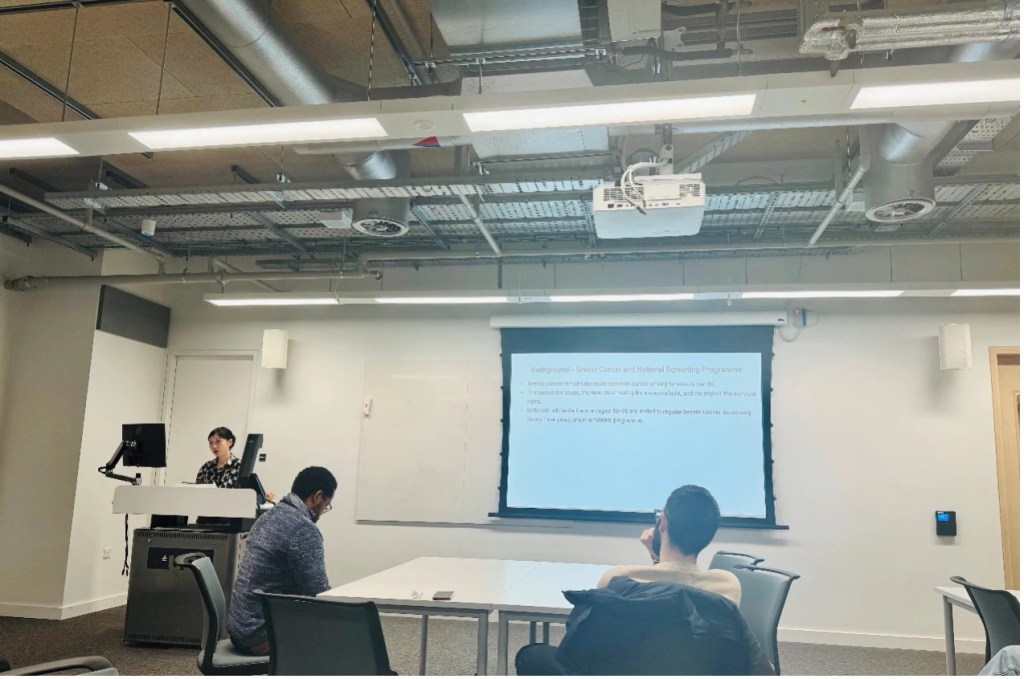
Dr Jin presenting at the symposium © ECHORA, 2025
Ms Zhengnan Zhu, research fellow from the London School of Hygiene & Tropical Medicine contributed insights from a methodologically sophisticated study titled “Cost effectiveness of non-ST elevation myocardial infarction (NSTEMI) management strategies for people with kidney impairment.” Drawing on large-scale linked health records, the team evaluated early invasive treatments—such as angiography, PCI, and CABG—against conservative management for patients with impaired renal function. The analysis employed a target trial emulation framework, bias adjustment via clone-censor-weight methods, and instrumental variable analysis using hospitals’ historical treatment preferences. The result: a rare glimpse into the causal cost-effectiveness of complex care pathways in a high-risk population.
From the University of Manchester, Ms Fanyi Su presented a feasibility study exploring the inclusion of health economic evaluation within a pilot trial of cognitive analytic therapy (CAT) for adults with a history of self-harm or suicide attempts. Their team investigated the practicality of collecting resource use and quality-of-life data (EQ-5D-5L) in this sensitive population. Early trends pointed to improved utility scores at 18 weeks for patients receiving CAT in addition to usual care, alongside indications that CAT may encourage more proactive help-seeking behaviours.
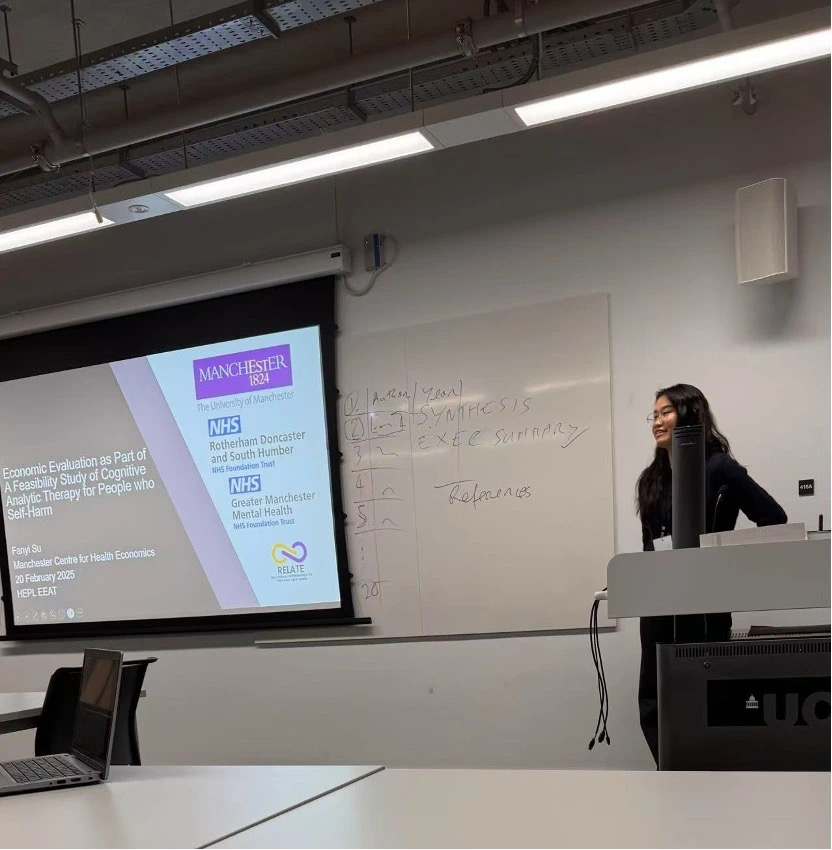
Ms Su during her presentation © ECHORA, 2025
Mr Kang Wang of King’s College London showed a comparative study entitled “Comparative Analysis of Secondary Healthcare Resource Use and Costs in Hospital Episode Statistics (HES) and Intensive Care National Audit & Research Centre (ICNARC) Datasets for ICU Patients: Insights from the STARRT-AKI Trial.” The research systematically assessed how these two major UK datasets captured resource use and costs for intensive care unit patients. Encouragingly, the team found no significant differences in cost estimates between the datasets, underlining their complementarity: HES offers broad coverage of secondary care, while ICNARC excels in critical care granularity—together forming a powerful base for generating real-world health economic evidence.
This symposium underscored the expanding frontier of economic evaluation in health research, spanning screening technologies, acute interventions, psychological therapies and real-world evidence infrastructures. The event fostered vital exchange across institutions and disciplines. For ECHORA’s emerging scholars, it was an opportunity not only to present cutting-edge work but to engage in deeper conversations around methodological challenges and collaborative futures.

 ECHORA Global